
Losing weight with home workouts – does it actually work?
For many people, working out at home feels like a more realistic way to get started than having to make it to the gym. When you can exercise on your own terms, in your own space, it lowers the barrier to getting going. And home workouts can be just as effective as training at the gym.


.svg)
Can you lose weight with home workouts?
To lose weight, you always need a calorie deficit. That means taking in less energy than your body uses over time. Exercise on its own rarely leads to weight loss, but it still plays an important role.
When you lose weight, you usually lose both fat mass and muscle mass. Without exercise, there’s a higher risk that a larger part of the weight loss comes from muscle. Losing muscle can slow down your metabolism and make it harder to maintain a lower weight in the long run. That’s why exercise is an important part of sustainable weight loss. The goal isn’t just to see the number on the scales go down, but to reduce body fat while keeping as much muscle as possible.
The best results usually come from combining changes to your diet with regular physical activity. Home workouts, for example using your own body weight, can be an easy and low-pressure option that helps you build a routine. Alongside a nutritious, balanced diet, this can support more long-term and sustainable results.
Who is home training suitable for?
If exercise has felt difficult, uncomfortable, or hard to fit into everyday life, working out at home can be a good option. Not having to travel to a gym, and being able to exercise in a familiar, safe environment without pressure or comparison, can make a big difference.
For anyone who wants to get fitter without going to a gym, home workouts can be a more accessible way to start. Simple tips and exercises can be adapted to your own ability and how you’re feeling on the day.
How to exercise at home
Bodyweight exercises at home
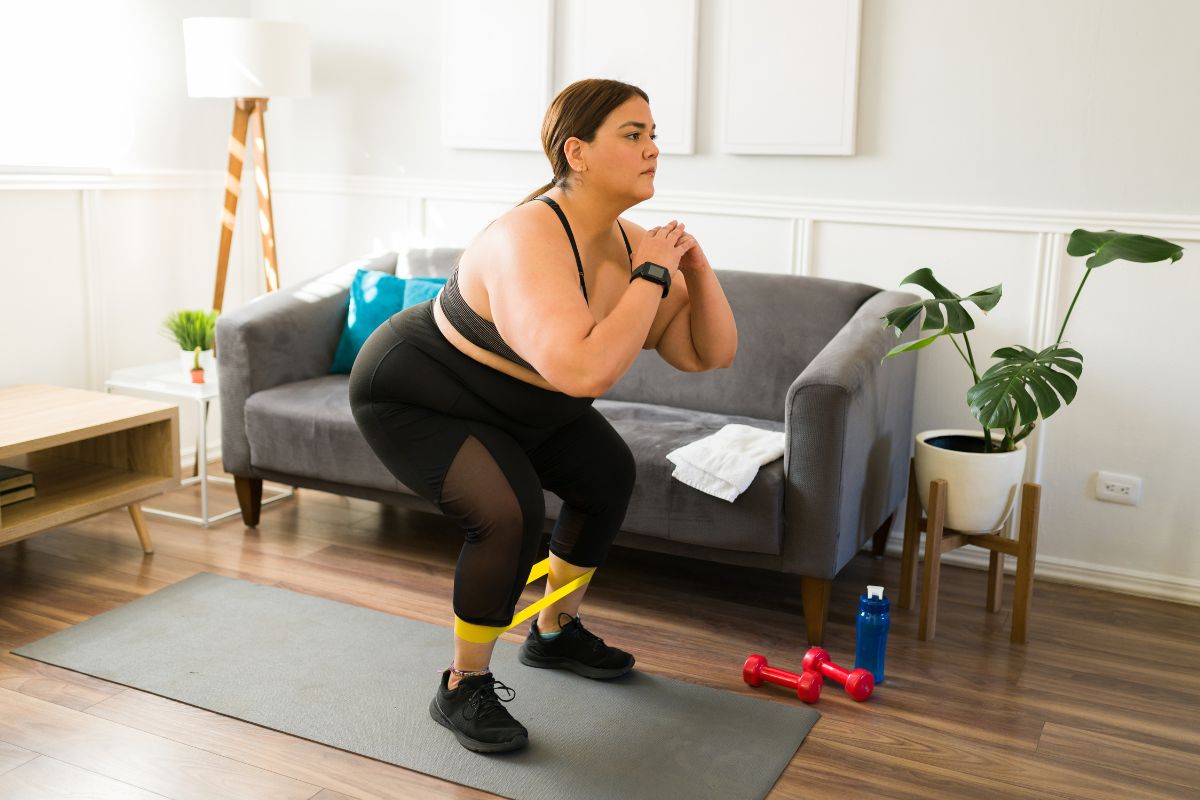
There are lots of exercises you can do at home to strengthen your body, with or without equipment. Bodyweight strength training is simple and accessible, but you can also add dumbbells, kettlebells, or resistance bands if you want more challenge.
Squats are a classic exercise that strengthen your legs and glutes. You lower yourself as if you’re sitting down on a chair, then stand back up. Press-ups work your upper body and can be done against a wall or on your knees to make them easier. Exercises like planks, crunches, or sit-ups, which strengthen your core and back, are also easy to do at home.
All of these exercises can be adapted to your own level and how your body feels that day, which makes bodyweight training a flexible option for home workouts.
Cardio at home
Cardio training at home can take many forms and be adjusted to your level and energy. One common option is circuit training, where you move between several exercises with short work periods. It can be an effective way to work the whole body and raise your heart rate in a short amount of time.
Examples of circuit exercises include chair squats, wall press-ups, towel rows, glute bridges, and kneeling planks. Each exercise can be done for a short time with rest in between, and the circuit can be repeated for several rounds. The key is to keep the intensity at a level that feels manageable and to focus on good technique. In other words, listen to your body. If you have equipment like a treadmill or a stationary exercise bike, these can also be good options for cardio at home.
Mobility and balance
Good mobility and balance are important for how your body functions in everyday life and during physical activity. Through mobility exercises, stretching, yoga, or balance training, you can improve joint movement, muscle control, and overall stability.
As mobility and balance improve, other types of physical activity often feel easier. This can make it simpler to keep moving and exercising without unnecessary limitations.
Walking and everyday movement
Home training doesn’t have to be complicated to be helpful. Walking is a great example of movement that can be adapted to your routine and fitness level. You can walk outdoors at a relaxed pace, walk on the spot at home, or follow a simple walking workout on video. Even shorter walks can support mobility, circulation, and energy levels.
How often do you need to exercise?
According to the World Health Organization (WHO), adults are recommended to be physically active regularly, with at least 150 to 300 minutes of moderate-intensity activity per week, or 75 to 150 minutes of higher-intensity activity. WHO also recommends strength training involving major muscle groups at least twice a week.
If you’re not exercising at all right now, the most important thing is to start moving. For many people, it’s more sustainable to begin small, for example with short sessions of five to ten minutes at a time. You can then gradually build up as your body gets used to movement. Consistency is often more important than the length of each session. Doing a little and often tends to work better than longer sessions that happen less frequently. Even short bursts of activity can have positive health effects when they add up over the week. Exercise should always be adapted to your own situation and can include a mix of cardio, strength training, and everyday movement.
Diet and weight loss
Diet is the most important factor when you want to lose weight, but that doesn’t mean you need to follow a specific diet. Weight loss isn’t just about eating less, but about making conscious, sustainable choices around food.
A balanced diet with carbohydrates, protein, and fat, along with enough vitamins and minerals, forms the foundation for long-term weight loss. In practice, this often means eating more vegetables and fruit, choosing wholegrain options, including lean protein sources, and using healthier fats. At the same time, it can help to limit foods that are high in energy but low in nutrition, such as highly processed foods, snacks, and sugary drinks.
Eating well doesn’t have to be complicated. It’s not about cutting out everything you enjoy, but about finding a balance where you can enjoy food and still lose weight. A simple first step can be to add more vegetables and fruit to your meals.
Sleep and stress management
When trying to lose weight, it’s easy to focus only on food and exercise. Sleep and stress levels are just as important for sustainable weight loss. Poor sleep and long-term stress can make it harder to stick to your eating and exercise habits. This can make weight loss feel more challenging, especially if you’re trying to lose weight quickly without allowing time for recovery.
That’s why it’s important to prioritise sleep and stress management. A regular sleep routine, where you go to bed and wake up at roughly the same time each day, can support your body’s recovery. Short breaks during the day, deep breathing, or simple relaxation exercises can also help reduce stress. By looking after both sleep and stress, you give your body better conditions for weight loss and improve your chances of feeling well throughout the process.
Home workouts as part of the bigger picture
For most people, home workouts work best when they’re part of a bigger picture. When home training is combined with a balanced diet, enough recovery, and stress management, the conditions for sustainable results are much better.
What matters most isn’t what your workouts look like or where you do them, but that they actually happen and are done regularly.
Summary
Losing weight with home workouts does work, but the best results come when home training is part of an overall approach. Weight loss requires a calorie deficit and is influenced by several factors, including diet, physical activity, sleep, and stress. Exercise alone is rarely enough, but it plays an important role in preserving muscle mass, supporting metabolism, and improving overall health and wellbeing.
Home workouts can be an accessible and flexible way to build regular movement into everyday life, whether that’s walking, bodyweight strength training, cardio, or mobility work. By adapting exercise to your own situation and focusing on consistency rather than perfection, you increase the chances of sticking with healthy habits over time. What fits into your life is often what leads to the most sustainable results in the long run.


January 27, 2026
March 2, 2026
Start your weight loss journey with Yazen today
Everything you need to do is to create an account and answer some questions about your health
.svg)
.svg)
More articles


Swimming as exercise – fitness, weight and health
Swimming as exercise is gentle, effective and suitable for most people – including those with overweight, osteoarthritis or after pregnancy. The buoyancy of water reduces the load on joints and the skeleton by up to 90%, making swimming a low-impact form of exercise that is very gentle on the body.
Barbell training for strength and muscle mass
Barbell training can be a simple and effective way to get started with strength training – whether you are a beginner or more experienced. With a few basic exercises, you train several major muscle groups and can adjust both weight and tempo after your daily form. Here you get practical advice on technique, common exercises, and how to train in a safe way.
Strength training for weight loss – for results that last
Many people who want to lose weight focus mainly on food and cardio. But strength training during weight loss plays a key role in both your results and how your body feels in the long run. By building and maintaining muscle mass, you can boost fat burning, lower the risk of regaining weight, and support a stronger, more functional body.